
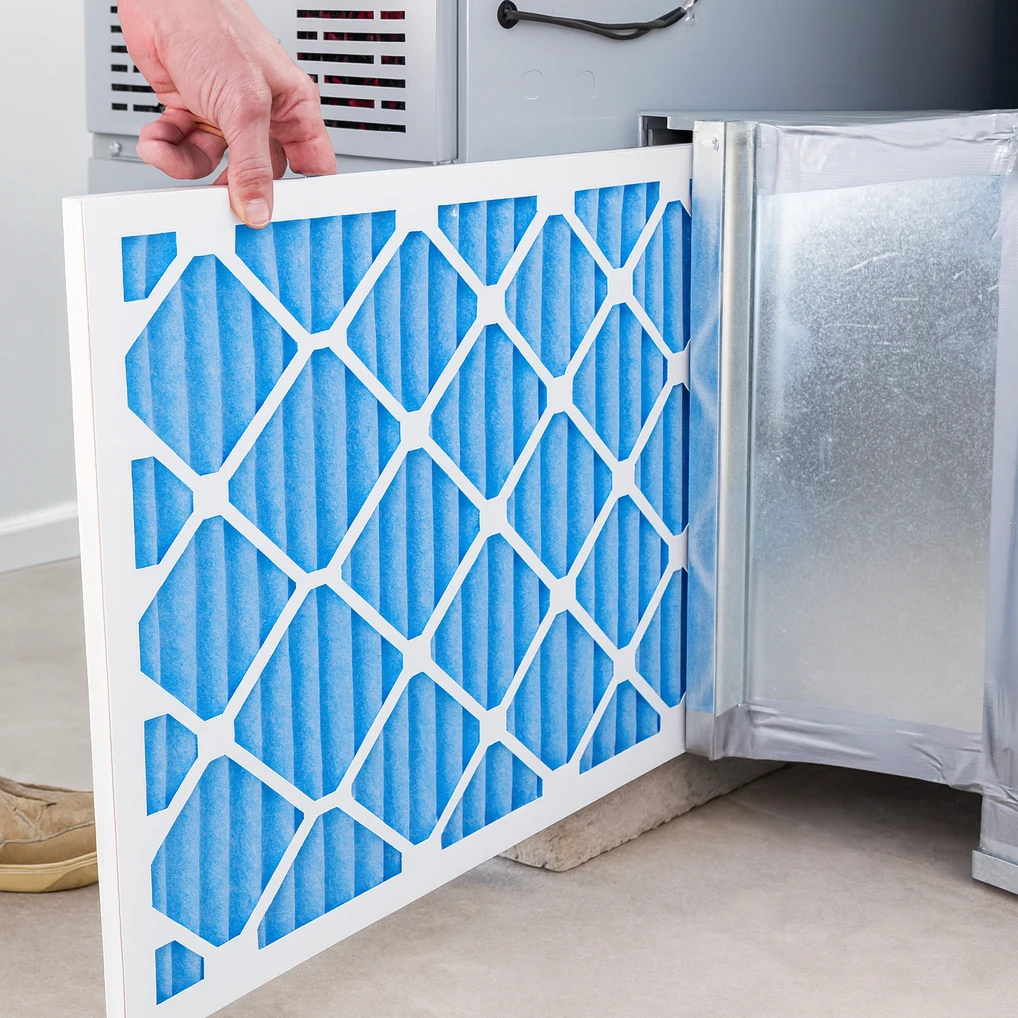
Furnace filters do more than protect your heating system, they also help keep the air inside your home cleaner and healthier. Understanding the different types of filters and how they’re rated will help you choose one that balances air quality, system protection, and efficiency for your home.
What Does a Furnace Filter Do?
The primary job of a furnace filter is to keep dust and debris from entering the furnace or air handler, which helps protect internal components like the blower and heat exchanger. The secondary benefit is improved indoor air quality by trapping airborne particles that would otherwise circulate through your home.
Filters capture particles of various sizes:
- Large particles: lint, pollen, and mold spores
- Medium particles: dust and pet dander
- Small particles: smoke and smog, often less than 0.3 microns
For comparison, a human hair is roughly 3 to 200 microns wide, so even the smallest airborne particles are invisible to the naked eye.
Filter Ratings Explained
MERV Rating (Minimum Efficiency Reporting Value)
The American Society of Heating, Refrigeration, and Air Conditioning Engineers (ASHRAE) developed the MERV scale to measure filter efficiency. Ratings range from 1 to 16, with higher numbers capturing smaller particles. Most residential HVAC systems perform best with filters in the MERV 8–13 range.
FPR Rating (Filter Performance Rating)
Some manufacturers, such as Home Depot, use the FPR system instead. This rating measures how well a filter captures particles from 0.3 to 1.0 microns—the size most likely to be inhaled. The scale typically runs from 300 to 1600, with higher numbers indicating better filtration.
Common Types of Furnace Filters
Fiberglass or Cellulose Pad: Low-cost and disposable. These filters trap larger particles like lint and dust but do little for smaller contaminants. They primarily protect equipment, not indoor air quality.
Washable/Reusable Filter: Made from metal or plastic mesh that can be rinsed and reused. They save money over time but must be cleaned monthly to remain effective. Some can be sprayed with a tacky coating to capture smaller particles.
Pleated Polyester Filter: More surface area for filtration and often made with electrostatically charged fibers. They capture finer particles and typically last up to three months.
Deep-Pleated, High-Efficiency Filter: Four to six inches thick and much more efficient at capturing small particles. These require a special filter housing and are ideal for homes concerned about allergens and dust.
Electronic Air Cleaner: Uses electricity to charge particles as air passes through, attracting them to collection plates. These remove up to 94% of small smoke and dust particles but require monthly cleaning and have a higher upfront cost.
Filter Efficiency Comparison
| Filter Type | Sub-Micron Particle Removal |
|---|---|
| Fiberglass | Up to 2% |
| Washable/Reusable | Up to 6% |
| Thin Pleated | Up to 11% |
| Deep Pleated | Up to 25% |
| Pleated Electrostatic | Up to 49% |
| Electronic | Up to 94% |
How Often Should You Replace or Clean Your Filter?
Most disposable filters should be replaced every 1 to 3 months, depending on usage and household conditions. Homes with pets or smokers may need to replace filters more often. Washable filters should be cleaned monthly.
Why Furnace Filters Matter for Health and Efficiency
A clean furnace filter not only improves air quality but also helps your heating and cooling system run more efficiently. Clogged filters restrict airflow, forcing your system to work harder and use more energy. Keeping filters clean can lower your energy bills by up to 15% while extending equipment life.
Filters also reduce common indoor irritants such as pollen, pet dander, and mold spores, important for anyone with asthma or allergies.
Choosing the Right Filter for Your Home
The ideal filter depends on your family’s needs. If allergies or respiratory sensitivities are a concern, a higher-rated pleated or electronic filter may be worth the investment. For general system protection, a mid-range pleated filter offers an excellent balance between airflow and air quality.
Need Expert Advice?
Not sure which furnace filter is right for your Colorado home? Contact Grand Lake Plumbing & Heating. Our HVAC specialists can help you select the best filter for your system and air quality goals.
